
It's 2084...
What real estate would you want to own 60 years from now?
Thank you all for your support in my newsletter journey. I am always humbled when a piece resonates with you, and I treasure each of your emails. In the theme of support, I have a free and easy favor to ask. I’m hosting my first webinar on Thursday, August 8, 2024 at 2pm ET. If you could please join and support me, that would mean the world. Here is the link to register. Thank you.
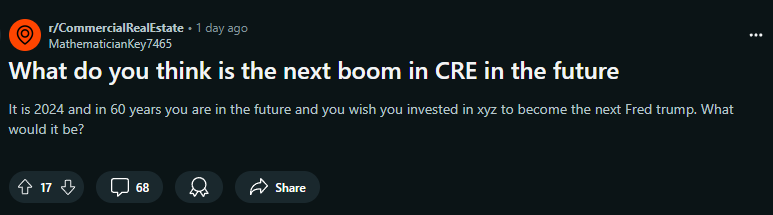
I saw the below post on the commercial real estate subreddit, and I couldn’t get it off my mind. Partially because 60 years from now is 2084 (any 1984 fans out there?) and partially because I was intrigued by the thought experiment.
Infrastructure
Roads
Here’s a comment that I found interesting.
“Also if no one is driving roadside signs can go full Vegas strip and have video and flashing lights.”
Let’s back up for a second. Yes, the land adjacent to roads would become even more valuable… but what about the roads themselves?
My husband and I have often debated the merits of privatizing roads. He always brings up David Friedman’s book, The Machinery of Freedom. For context, Friedman wrote this book in 1970 and has been credited with predicting Uber taking over municipal run taxis. Maybe he’s right on privatizing roads also.
Here’s an excerpt about Friedman’s prediction.
The rush hour problem is a good example. The size of city expressways is determined almost entirely by the peak traffic that they have to bear. The extra cost to the city of an additional driver at 3 a.m. is essentially zero—the roads are there anyway and nobody is using them. The extra cost of an extra driver at rush hour averages out, I am told, to about five dollars per trip. Presently, both drivers are charged the same price, in the form of higher gas costs due to gas taxes. If the roads were privately run, it would pay their owners to encourage offhour traffic by charging a low price and to discourage people from driving at rush hour by charging them the full cost of their trip.
The imposition of variable charges is not the only improvement that a profit-making corporation could make. Traffic jams are minor inconveniences to a government bureau; to a private corporation, they mean the loss of a small fortune in potential customers. Traffic jams are not the inevitable result of many people wanting to drive at once. The rate of traffic flow in a jammed expressway, with cars taking up twenty feet apiece and moving at five miles an hour, is far lower than in the same expressway with traffic at 50 miles an hour and each car taking up 60 or 80 feet. A well-operated expressway with computer control of entrance to keep people out when traffic density got too high or with holding lots into which surplus traffic could be temporarily diverted in order to speed up traffic flow, would get everyone to his destination sooner.
Friedman makes some compelling arguments. But I had a hard time finding examples of private roads as major thoroughfares. I have to imagine the legal efforts would be nothing short of what Herb Kelleher did with Southwest; he spent three years in court before Southwest ever flew a plane.
An example of private roads that did make the news were Disney’s. You may remember their battle with Governor DeSantis. Disney made a statement about a controversial law, and DeSantis took over a portion of their park for city services, including road maintenance. DeSantis ultimately won the legal battle for control over those roads, but Disney won by gaining the rights for a new development. I imagine their development is worth a lot more than a few roads. Not only that, former Disney employees were hired to oversee the now government-managed land that they were already overseeing.
The moral of the story is this: even though you run the risk of losing private roads to government, I guess you win by using them as leverage?
Another fun example of private infrastructure is the NYC subway. I didn’t know this until recently, but the subway was actually developed by two private companies: the Brooklyn Rapid Transit Company and the Interborough Rapid Transit Company. The NYC government also built and operated a third line. Then, the three lines were consolidated in 1940 when New York City “…purchased all of the rights of the private rapid transit operators.”
So if you’re investing in private infrastructure such as roads, subways, or other transportation, you’d have to include governments in your underwritten exit plan. And your ROI may not be simply the exit price.
Why would investing in private roads matter now, though? I’ve heard more and more about PE real estate firms branching into infrastructure. The net returns just aren’t there for value-add real estate anymore, but they are for infrastructure. Lord knows we need a lot of updates to roads, bridges, and other methods of transit all across the country. That said, while we are a rich nation, we also have loads of debt. I have a feeling we’ll see more privatization and more public-private partnerships to help pay for these infrastructure upgrades.
Power Plants
Another infrastructure need right now is for more power plants. Power plants were not mentioned in the subreddit thread, but they’re worth calling out, particularly because of AI. We need terawatts more power for AI. Terawatts. Data centers are straining our already strained power grid. For any of you who lived in Texas during Snowpacolypse, you know what I mean.
According to a recent article by the WSJ, one-third of nuclear power plant owners are now working with big tech companies to power data centers. Many of the concerns about nuclear power’s safety have been solved already. Regardless of whether you care about energy being clean and green, nuclear provides cheap, reliable power. I’d be surprised if nuclear power plants were not the norm in 2084.
Medical Office
Another interesting quote from a comment:
“Medical office - I think that will be the bigger bet in the future. Unlike assisted living which can possibly be disrupted by a number of factors, medical office is probably here to stay indefinitely. I don't see doctors making house calls anytime in the near future. Betting big on medical office is probably a safe bet.”
Anytime I hear the word “indefinitely”, I feel like my dog when his ears perk up. And then I immediately tilt my head. Indefinitely, really?
I’ll take that bet.
Why couldn’t doctors make house calls? Veterinarians already do. We already expect massive medical advances to come from AI. That should allow us to treat most patients without carrying around bulky and expensive equipment. And on that note, why wouldn’t the equipment become more condensed over time? That’s exactly what happens with technology, e.g. Moore’s Law. Then as competition grows, that new tech becomes cheaper and more widespread.
Plus, it would be a heck of a lot more efficient for doctors to come to patients in need of care. Patients may be severely injured or in distress and not able to easily travel. Doctors, on the other hand, would be healthy or they wouldn’t be working that day.
Not only that, hospitals are notoriously cesspools for viruses. I haven’t seen as many studies on medical office buildings, but I’d imagine the same. Why not reduce the exposure of patients to a doctor, nurse, or if absolutely necessary, a handful of doctors and nurses, rather than a ward of other sick patients?
I’m sure we’ll still need medical office for the next decade, maybe even four. But 60 years from now? I don’t think so.
Industrial
Data centers are only becoming more and more necessary. Distribution and cold storage as well. I’d be surprised if this trend of having goods brought directly to consumers doesn’t continue.
Housing and Farmland
We will always need housing and farmland. Full stop. And if population growth continues, we’ll need even more of both. According to the UN, “The world’s population is expected to grow by more than 2 billion people in the next decades and peak in the 2080s at around 10.3 billion.” The trends of what kinds of housing people want will change, but we’ll need it either way. Same with agricultural trends and inventions changing the landscape of farmland.
The 1984 Analogy
I couldn’t help but compare the redditor’s post to 1984. What could go wrong in 2084? My short list:
Famine → the world becomes overpopulated, and we can’t make enough food.
World Wars → always a risk. As the global population becomes richer and demands more energy, competition for it could add fuel to the fire.
Finance and tech rule the world → neither are on the bottom of Maslow’s pyramid; what if the level of complexity becomes too much for society to handle? Particularly in the event of a tech disaster, will we become so reliant on AI agents that we don’t know how to do simple tasks that have enabled our species to thrive all these centuries? Maybe I’ve been reading too many dystopian novels…
I’d love to hear your thoughts. Drop me a note in the comments or reply via email.
Jen’s Reading Corner
I gotta reference George Orwell’s 1984 here. It’s the classic story of Big Brother that everyone should read.
If you like All About CRE and want to support my work:
😍 Plan a media partnership
🪄 Book a one-on-one CRE tech coaching session
☕ Buy me a coffee
📧 Forward this to a friend and invite them to subscribe at jentindle.substack.com